

SWOT Analysis in Business
In today’s competitive world, every business wants to stay ahead of the game. That’s why companies use SWOT Analysis to understand where they stand, what they do well, and where they need to improve. It works like checking a map before a long journey, helping teams avoid wrong turns and make smarter decisions.
A SWOT Analysis is a simple strategic planning framework that supports business strategy, acts as a decision-making framework, and strengthens risk management. It gives a clear picture of internal strengths and weaknesses, along with external opportunities and threats, so businesses can plan with confidence instead of guesswork.
What is SWOT Analysis?
SWOT Analysis is a strategic planning method used to evaluate a business, project, or idea by examining four key areas: Strengths, Weaknesses, Opportunities, and Threats. It helps organizations understand both what they control internally and what they must respond to externally.
The concept was developed in the 1960s by researcher Albert Humphrey, who analyzed data from Fortune 500 companies to improve strategic management and organizational development.
Internal vs External Factors
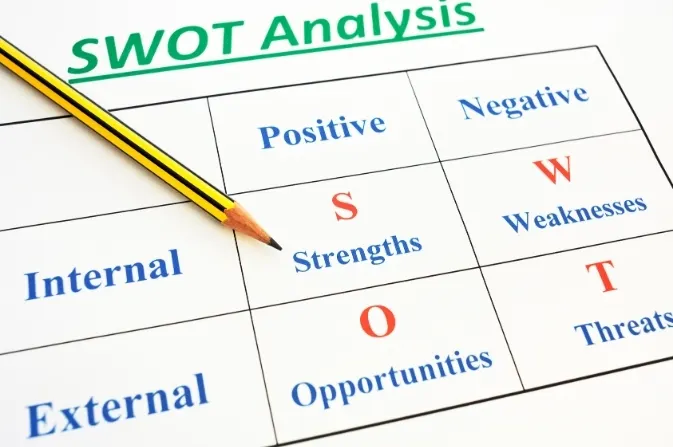
Strengths and Weaknesses (Internal Factors)
These are factors within the business that the company can control, such as people, skills, tools, systems, and processes. Strong customer service or skilled employees are strengths, while limited budgets or outdated systems are weaknesses.
Opportunities and Threats (External Factors)
These come from outside the business, including market trends, customer behaviour, competition, and economic conditions. A growing market may be an opportunity, while new competitors or regulations may be threats.
Recommended Read: Top Challenges SME Face in Nepal
Importance of SWOT Analysis in Business
A SWOT analysis gives businesses a clear “big-picture” view before they make strategic decisions. It helps leaders understand where to focus time, money, and effort.
Here are some points that can help you understand the importance of SWOT analysis better:
- Helps build strong business strategies
- Improves decision-making
- Reveals competitive advantages
- Supports long-term planning
- Helps manage risks early
Benefits for different business sizes
SWOT analysis helps different businesses in different ways.
- Startups: Use SWOT to shape their first strategy and avoid early mistakes.
- Small businesses: Use it to stay focused and use limited resources wisely.
- Large companies: Use it to stay competitive in fast-changing markets.
Recommended Read: Business Strategy Every Nepali Businesses Should Know
Limitations of SWOT Analysis
There are some limitations as well when it comes to SWOT analysis.
- Can be too broad without a clear objective
- Depends on honest and accurate inputs
- It may reflect bias if the wrong people are involved
- Needs regular updates to stay useful
If you’re unsure how to apply SWOT insights to real business decisions, Milan Khatiwoda, a business consultant in Nepal, helps organizations translate SWOT analysis into clear and practical strategies.
What Are the Components of SWOT Analysis?
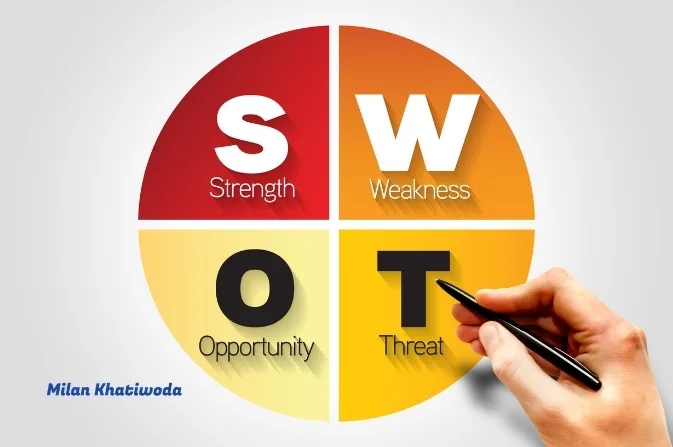
A SWOT Analysis is built around four core components that together create a complete business snapshot.
| Component | Description | Example |
|---|---|---|
| Strengths | What the company does well | Strong brand, loyal customers |
| Weaknesses | Areas that need improvement | Limited budget, slow delivery |
| Opportunities | External chances for growth | New markets, rising demand |
| Threats | External risks or challenges | Competitors, new laws |
Step-by-Step Guide to Conduct a SWOT Analysis
Here is a simple and practical SWOT Analysis step-by-step guide:
- Define your objective
Decide what you are analyzing, such as a business, product, service, or strategy. - Gather a diverse team
Include people from marketing, finance, operations, and customer support. - Brainstorm internal and external factors
List strengths, weaknesses, opportunities, and threats honestly. - Prioritize important factors
Focus on points that have the biggest impact. - Combine and refine findings
Remove duplicates and unclear ideas. - Build your SWOT matrix
Place each factor in the correct quadrant. - Create an action plan
Example: Use strong customer loyalty to expand online sales. - Monitor and update regularly
SWOT should evolve as the market and business change.
Applying these steps correctly can be challenging. Milan Khatiwoda, a trusted business consultant in Nepal, works with startups and growing businesses to turn SWOT analysis into actionable business plans.
SWOT Analysis in Action: Real-Life Examples
Here are some real-life examples of how different businesses use SWOT analysis that can help you improve your business.
Apple
Apple uses SWOT to protect its premium brand while adapting to market change.
- Strength: Strong brand loyalty
- Weakness: High prices
- Opportunity: Wearable technology growth
- Threat: Fast-growing competitors
Tesla
Tesla relies on SWOT to guide innovation in a competitive EV market.
- Strength: Innovation
- Weakness: Production bottlenecks
- Opportunity: Global shift to electric vehicles
- Threat: Improving competitor technology
SaaS Company Example
A SaaS company uses SWOT analysis to plan product expansion.
- Strength: Automated onboarding
- Weakness: Limited support hours
- Opportunity: Rising demand for automation
- Threat: New SaaS startups
Recommended Read: How Can FDI Impact Business Growth in Nepal?
SWOT vs Other Business Tools
SWOT is often compared with other business strategy tools. Each tool serves a different purpose.
| Tool | Purpose | Best Use Case |
|---|---|---|
| SWOT Analysis | Internal and external review | Overall planning |
| PEST Analysis | Political, economic, social, tech factors | External analysis |
| Porter’s Five Forces | Industry competition | Market entry |
| Balanced Scorecard | Performance tracking | Long-term goals |
Common Mistakes to Avoid in SWOT Analysis
Here are some common mistakes that you have to avoid for doing SWOT analysis:
- Not setting a clear objective
- Using biased or vague information
- Adding too many unnecessary points
- Mixing internal and external factors
- Treating SWOT as a one-time exercise
Tips for Effective SWOT Analysis
Here are some tips that you can follow to make your SWOT analysis more effective:
- Base insights on real data
- Involve the right people
- Turn findings into actions
- Review and update SWOT regularly
Final Thoughts
A SWOT Analysis remains one of the most practical tools for strategic planning. When used correctly, it helps businesses make smarter decisions, reduce risks, and identify growth opportunities.
For businesses that want expert guidance beyond theory, Milan Khatiwoda, a business consultant in Nepal, helps organizations turn SWOT analysis into clear direction, stronger strategies, and sustainable growth. Contact Today for your SWOT Analysis.
Frequently Asked Questions About SWOT Analysis
SWOT Analysis gives leaders a full view of the business environment. It highlights what the company does well, where it struggles, and what external factors matter. With these insights, decision-making becomes clearer and less risky. For example, a strength like strong customer loyalty can guide decisions to expand new services confidently.
Businesses often use SWOT during important moments — launching a product, entering new markets, planning yearly goals, or facing stronger competition. Many companies also update their SWOT every 6–12 months to stay aligned with changing market trends.
Companies look at trends, customer needs, and technology changes in the Opportunities section. When opportunities match company strengths, growth becomes easier. For example, if customers prefer online shopping and the company has a strong website, expanding into e-commerce becomes a clear opportunity.
SWOT helps marketers choose the right direction. Strengths show what to highlight in ads, weaknesses reveal what to improve, opportunities help find new audiences, and threats warn marketers about what could affect campaigns. This makes marketing more targeted and effective.
Yes. By identifying threats early, like new competitors, economic shifts, or technology changes, SWOT helps businesses prepare and stay flexible. While it can’t predict everything, it works like an early-warning system that allows companies to act before problems grow.
Internal factors (strengths and weaknesses) show what a business can control, like skills, money, or tools. External factors (opportunities and threats) show what happens outside the business, like market changes or new competitors. Together, they create a full picture of what the company should focus on next.